
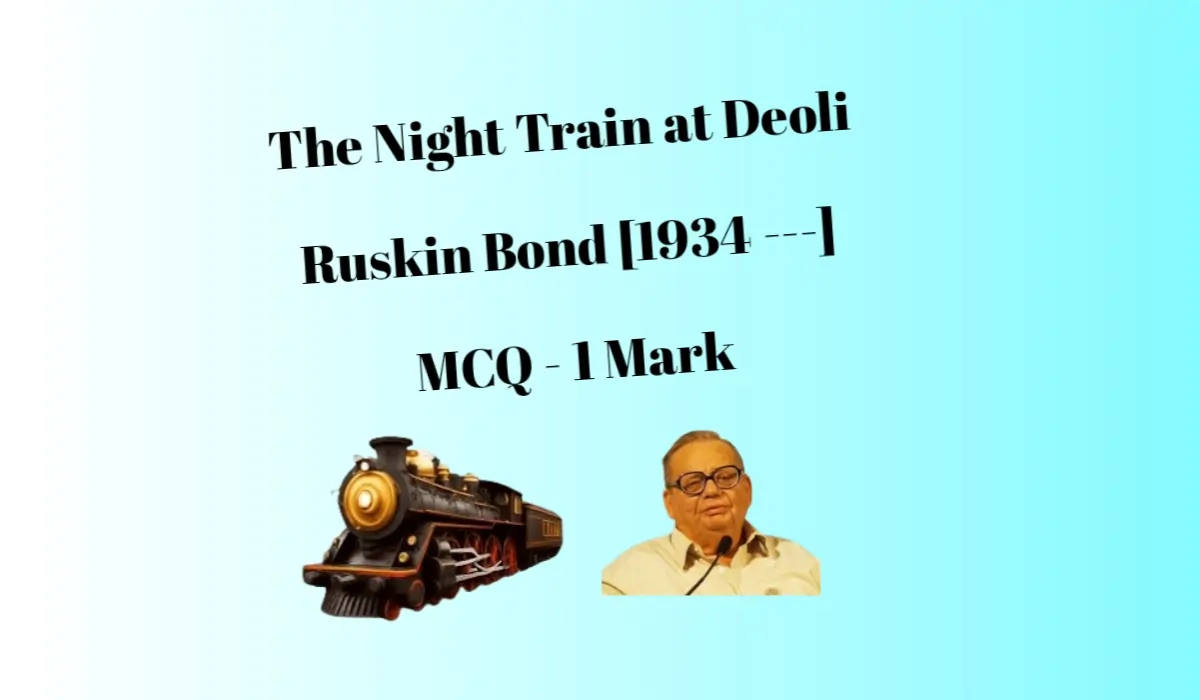
The Night Train at Deoli – A Famous Short-story First Published in 1988
‘The Night Train at Deoli’ by Ruskin Bond [1934 —] is a tale of unfulfilled love and longing, set against the backdrop of a quiet, small railway station in India.
Ruskin Bond [1934 —] An Indian-born Writer with British Descent
The Night Train at Deoli MCQ – 1 Mark Important Questions
132 Different Categorical Important Questions
Informative
Q1. During his college days, the narrator spent his summer vacations in —
View Answer & Explanation
Correct Answer: (C) Dehra.
Explanation:
Q2. The narrator stayed in Dehra from —
View Answer & Explanation
Correct Answer: (D) May to late July.
Explanation:
Q3. Deoli station was marked by —
View Answer & Explanation
Correct Answer: (D) the beginning of the heavy jungles of the Indian Terai.
Explanation:
Q4. The distance from Dehra to Deoli was —
View Answer & Explanation
Correct Answer: (B) thirteen miles.
Explanation:
Q5. The title ‘The Night Train at Deoli’ suggests that —
View Answer & Explanation
Correct Answer: (D) the train reached Deoli after a overnight journey.
Explanation:
Q6. In the early morning Deoli station was lighted by —
View Answer & Explanation
Correct Answer: (D) oil-lamps and electric bulbs.
Explanation:
Q7. The train stopped at Deoli station for —
View Answer & Explanation
Correct Answer: (D) ten minutes.
Explanation:
Q8. When the narrator first met the girl, he was —
View Answer & Explanation
Correct Answer: (D) eighteen.
Explanation:
Q9. ‘Her feet were bare and her clothes were old.’ —Here the description of the girl suggests that:
View Answer & Explanation
Correct Answer: (B) she belonged to a poor family.
Explanation:
Q10. The narrator first met the girl in a —
View Answer & Explanation
Correct Answer: (A) winter morning.
Explanation:
Q11. ‘When she came to my window, she stopped.’ — Here the line refers to the window of the:
View Answer & Explanation
Correct Answer: (A) train compartment.
Explanation:
Q12. The most befitting description of the followings given by the narrator about the girl was —
View Answer & Explanation
Correct Answer: (D) troubled appearance.
Explanation:
Q13. The baskets which the girl of Deoli was selling were made of —
View Answer & Explanation
Correct Answer:
Explanation:
Q14. The narrator paid for the basket —
View Answer & Explanation
Correct Answer: (D) one rupee.
Explanation:
Q15. The narrator first talked with the girl at Deoli —
View Answer & Explanation
Correct Answer: (A) during his journey to Dehra and to his college in the plains.
Explanation:
Q16. When the narrator saw the girl for the second time, he experienced a feeling of —
View Answer & Explanation
Correct Answer: (D) unexpected thrill.
Explanation:
Q17. After his first meeting, the feature of the girl haunted the narrator’s mind was her —
View Answer & Explanation
Correct Answer: (A) face and dark eyes.
Explanation:
Q18. ‘But when I reached Dehra the incident became blurred and distant’ — The ‘incident’ here refers to:
View Answer & Explanation
Correct Answer: (B) the narrator’s first meeting with the girl at Deoli.
Explanation:
Q19. The narrator met the girl second time at Deoli —
View Answer & Explanation
Correct Answer: (A) two months after his first meeting.
Explanation:
Q20. The narrator had to go to Delhi for —
View Answer & Explanation
Correct Answer: (A) attending his college.
Explanation:
Q21. When the narrator and the girl met for the second time —
View Answer & Explanation
Correct Answer: (A) both of them were pleased.
Explanation:
Q22. When the narrator and the girl met for the first time in the tea-stall, the owner of the tea-stall was —
View Answer & Explanation
Correct Answer: (A) absent.
Explanation:
Q23. The jungle across the railway station was visible —
View Answer & Explanation
Correct Answer: (B) in the faint light of dawn.
Explanation:
Q24. After ten minutes of halt at Deoli station, the train rushed into —
View Answer & Explanation
Correct Answer: (D) the forest of Indian terai.
Explanation:
Q25. The train reached Deoli at —
View Answer & Explanation
Correct Answer: (C) about five in the morning.
Explanation:
Q26. On the platform of Deoli station the little girl was selling —
View Answer & Explanation
Correct Answer: (B) baskets.
Explanation:
Q27. Their wares were not sold on the platform of Deoli by —
View Answer & Explanation
Correct Answer: (C) newspaper hawker.
Explanation:
Q28. To keep herself warm, the basket-selling girl put on —
View Answer & Explanation
Correct Answer: (A) a shawl.
Explanation:
Q29. The narrator felt sorry for the lonely platform of Deoli as —
View Answer & Explanation
Correct Answer: (A) nobody wanted to visit the place.
Explanation:
Q30. On the platform of Deoli station there was not —
View Answer & Explanation
Correct Answer: (B) coolies.
Explanation:
Q31. At the time of the narrator’s first meeting with the girl the tea-vendor was absent in the tea-stall as —
View Answer & Explanation
Correct Answer: (A) he was serving tea somewhere in the train.
Explanation:
Q32. ‘They are very strong, made of the finest cane …’ — Here ‘they’ refers to the:
View Answer & Explanation
Correct Answer: (D) baskets.
Explanation:
Q33. The words that the girl at Deoli station uttered was lost in the —
View Answer & Explanation
Correct Answer: (B) clanging of the bell and the hissing of the engine.
Explanation:
Q34. ‘I took the one on top and gave her a rupee’ —The narrator of the story ‘The Night Train at Deoli’ took:
View Answer & Explanation
Correct Answer: (D) a basket.
Explanation:
Q35. The thing came in the way of the narrator to obstruct his views of the girl standing on the platform of Deoli was —
View Answer & Explanation
Correct Answer: (C) a signal box.
Explanation:
Q36. The narrator of the story ‘The Night Train at Deoli’ compared his second meeting with the girl as a —
View Answer & Explanation
Correct Answer: (A) meeting of old friends.
Explanation:
Q37. When the narrator reached Dehra, the incident of his meeting with the girl became blurred because —
View Answer & Explanation
Correct Answer: (A) there were other things to occupy his mind.
Explanation:
Q38. The commitment that the narrator made to the girl was —
View Answer & Explanation
Correct Answer: (C) ‘I will come again’.
Explanation:
Q39. The option among ones best describes the category of the story ‘The Night Train at Deoli’ is —
View Answer & Explanation
Correct Answer: (A) a story of strange love and longing.
Explanation:
Q40. The narrator took the baskets from the hands of the girl —
View Answer & Explanation
Correct Answer: (D) to put them down on the ground.
Explanation:
Q41. The narrator told the girl that —
View Answer & Explanation
Correct Answer: (C) he had to go to Delhi.
Explanation:
Q42. The author wrenched his hand away from the girl —
View Answer & Explanation
Correct Answer: (A) to get to his train compartment as the train was about to leave.
Explanation:
Q43. When his college term finished, the narrator started for Dehra —
View Answer & Explanation
Correct Answer: (B) earlier than usual.
Explanation:
Q44. After the completion of college term when the train drew into Deoli during his journey, the narrator felt —
View Answer & Explanation
Correct Answer: (A) nervous and anxious.
Explanation:
Q45. ‘I was determined that I wouldn’t stand helplessly before her, hardly able to speak or do anything about my feelings’ — The feeling that the speaker had about ‘her’ was a feeling of:
View Answer & Explanation
Correct Answer: (C) love and attraction.
Explanation:
Q46. After the completion of his college term, the narrator left for Dehra earlier than usual —
View Answer & Explanation
Correct Answer: (A) for his eagerness to meet the girl.
Explanation:
Q47. After the narrator couldn’t find the girl at Deoli, the first person the narrator encountered was —
View Answer & Explanation
Correct Answer: (A) the old station-master.
Explanation:
Q48. The station-master, regarding the girl, informed the narrator that —
View Answer & Explanation
Correct Answer: (A) he did not know her.
Explanation:
Q49. The narrator viewed across the fence at Deoli station —
View Answer & Explanation
Correct Answer: (D) a mango tree and a dusty road leading into the jungle.
Explanation:
Q50. The tree that the narrator spotted past the railings of Deoli station was —
View Answer & Explanation
Correct Answer: (C) a mango tree.
Explanation:
Q51. The narrator’s emotions when he didn’t find the girl on Deoli’s platform were —
View Answer & Explanation
Correct Answer: (D) deeply disappointed.
Explanation:
Q52. The narrator encountered the girl —
View Answer & Explanation
Correct Answer: (B) twice.
Explanation:
Q53. After leaving Deoli, the train rushed through —
View Answer & Explanation
Correct Answer: (D) forests.
Explanation:
Q54. After finishing his college education, the narrator stayed in Dehra for —
View Answer & Explanation
Correct Answer: (B) two weeks.
Explanation:
Q55. The narrator’s grandmother was upset about his visit to Dehra because —
View Answer & Explanation
Correct Answer: (B) he didn’t stay long enough.
Explanation:
Q56. The narrator portrayed the tea-stall owner as a —
View Answer & Explanation
Correct Answer: (B) small, shriveled-up man.
Explanation:
Q57. The tea-stall owner wore —
View Answer & Explanation
Correct Answer: (A) greasy clothes.
Explanation:
Q58. While searching for the girl, the narrator realized —
View Answer & Explanation
Correct Answer: (C) he had no knowledge of the girl at all.
Explanation:
Q59. The girl selling baskets aroused __________ in the narrator.
View Answer & Explanation
Correct Answer: (D) tenderness and responsibility
Explanation:
Q60. The narrator learnt the new station-master had started —
View Answer & Explanation
Correct Answer: (B) a week ago.
Explanation:
Q61. The narrator cut short his stay in Dehra —
View Answer & Explanation
Correct Answer: (C) to ask the station-master about the girl.
Explanation:
Q62. The tea-vendor told the narrator about the girl with baskets that —
View Answer & Explanation
Correct Answer: (C) she had stopped coming to the station.
Explanation:
Q63. The girl captivated the narrator’s heart with her —
View Answer & Explanation
Correct Answer: (B) dark, impatient eyes.
Explanation:
Q64. The narrator in his final college semester regarding the girl hoped that —
View Answer & Explanation
Correct Answer: (C) he’d make inquiries and find her someday.
Explanation:
Q65. The word which was not used by the narrator when describing the basket girl was —
View Answer & Explanation
Correct Answer: (B) beautiful.
Explanation:
Q66. ‘Her dark eyes were suddenly filled with light.’ — This line suggests that:
View Answer & Explanation
Correct Answer: (D) the girl was pleased to see the narrator.
Explanation:
Q67. When the narrator and the girl met the second time, he suddenly felt that —
View Answer & Explanation
Correct Answer: (C) he would board the train and take her along.
Explanation:
Q68. To the narrator’s question: ‘Will you be here?’ the girl responded by —
View Answer & Explanation
Correct Answer:
Explanation:
Q69. The narrator’s grandmother’s home was at /in —
View Answer & Explanation
Correct Answer: (A) Dehra.
Explanation:
Q70. The narrator didn’t interrupt his train journey at Deoli because —
View Answer & Explanation
Correct Answer: (B) he didn’t want to lose hope.
Explanation:
Q71. The writer claims the story ‘The Night Train at Deoli’ is —
View Answer & Explanation
Correct Answer: (D) a true event.
Explanation:
Q72. The narrator left Dehra early after college because of —
View Answer & Explanation
Correct Answer: (D) the basket girl.
Explanation:
Q73. The girl’s attire was —
View Answer & Explanation
Correct Answer: (A) old.
Explanation:
Q74. The narrator scans the Deoli platform every time his train passes through because —
View Answer & Explanation
Correct Answer: (A) he hopes to see the same girl again.
Explanation:
Q75. The girl carried her baskets —
View Answer & Explanation
Correct Answer: (C) in her arms.
Explanation:
Q76. To the narrator the Deoli station was —
View Answer & Explanation
Correct Answer: (D) one he passed often.
Explanation:
Q77. Upon seeing the narrator for the second time, the girl —
View Answer & Explanation
Correct Answer: (A) went directly to the tea-stall to meet him.
Explanation:
Q78. When the narrator didn’t find the girl on the platform, out of disappointment, he —
View Answer & Explanation
Correct Answer: (B) ran to the station-master.
Explanation:
Q79. The station-master advised the narrator —
View Answer & Explanation
Correct Answer: (D) to board the train quickly.
Explanation:
Q80. The narrator usually spent his holidays in Dehra —
View Answer & Explanation
Correct Answer: (B) in his college vacations.
Explanation:
Q81. When the girl walked on the platform, the narrator observed that she walked —
View Answer & Explanation
Correct Answer: (C) gracefully.
Explanation:
Q82. The basket girl followed the narrator to —
View Answer & Explanation
Correct Answer: (C) tea-stall.
Explanation:
Q83. The shawl over the girl’s shoulder indicated that —
View Answer & Explanation
Correct Answer: (C) it was a cold morning.
Explanation:
Q84. The narrator held the girl’s hand —
View Answer & Explanation
Correct Answer: (C) in their second meeting.
Explanation:
Q85. The word ‘here’ in the question ‘Do you know the girl who used to sell basket here?’ refers to —
View Answer & Explanation
Correct Answer: (C) Deoli railway station.
Explanation:
Sample Questions
Q86. In Ruskin Bond’s short-story ‘The Night Train at Deoli’, the narrator meets the young girl —
View Answer & Explanation
Correct Answer: (C) on the railway platform at Deoli.
Explanation:
Q87. The narrator is captivated by in the young girl’s —
View Answer & Explanation
Correct Answer: (C) quiet dignity and dark troubled eyes.
Explanation:
Q88. The narrator repeatedly visits Deoli station to —
View Answer & Explanation
Correct Answer: (C) meet the young girl again.
Explanation:
Model Questions
Q89. The narrator’s primary motivation for visiting Deoli station is —
View Answer & Explanation
Correct Answer: (C) expecting to encounter the young girl again.
Explanation:
Q90. The physical characteristic of the young girl which draws the narrator’s attention is —
View Answer & Explanation
Correct Answer: (C) her dark and troubled eyes.
Explanation:
Q91. The story’s title ‘The Night Train at Deoli’ suggests a sense of —
View Answer & Explanation
Correct Answer: (C) mystery and longing.
Explanation:
Q92. The words which best describe the narrator’s emotional state in the story are —
View Answer & Explanation
Correct Answer: (C) tenderness and longing.
Explanation:
Filling the Blanks
Q93. The narrator used to spend his ____________ vacations in Dehra, at his grandmother’s house.
View Answer & Explanation
Correct Answer: (C) summer
Explanation:
Q94. The platform boasted a tea-stall, a ____________ vendor and a few stray dogs.
View Answer & Explanation
Correct Answer: (A) fruit
Explanation:
Q95. She had a pale skin, set off by ____________ hair, and dark troubled eyes.
View Answer & Explanation
Correct Answer: (B) shiny black
Explanation:
Q96. At the time of giving a rupee to the girl the narrator had a desire to touch her ____________.
View Answer & Explanation
Correct Answer: (D) fingers
Explanation:
Q97. But when I reached ____________ the incident became blurred and distant.
View Answer & Explanation
Correct Answer: (C) Dehra
Explanation:
Q98. The narrator stared over the railings at the station yard of Deoli and saw a ____________ tree and a ____________ road leading into the jungle.
View Answer & Explanation
Correct Answer: (A) mango, dusty
Explanation:
Q99. The basket-selling girl stole the narrator’s heart with nothing but her dark ____________.
View Answer & Explanation
Correct Answer: (C) eyes
Explanation:
Q100. She nodded, “I do not have to go ____________.”
View Answer & Explanation
Correct Answer: (D) nowhere
Explanation:
Q101. The narrator took the train back to the plains within two weeks as he wanted to ask further questions to the ____________.
View Answer & Explanation
Correct Answer: (B) station-master
Explanation:
Q102. The guard blew his whistle for the train to leave and how I ____________ the guard for doing that.
View Answer & Explanation
Correct Answer: (C) hated
Explanation:
Q103. ‘What could I do about finding a girl I had seen only ____________ , who had hardly spoken to me…?’
View Answer & Explanation
Correct Answer: (A) twice
Explanation:
Q104. The girl followed the narrator to the ____________ .
View Answer & Explanation
Correct Answer: (C) tea-stall
Explanation:
Q105. The narrator asked ____________ person/persons about the girl with the baskets.
View Answer & Explanation
Correct Answer: (C) three
Explanation:
Q106. The narrator decided many times to break his journey and spend a ____________ in the town of Deoli.
View Answer & Explanation
Correct Answer: (B) day
Explanation:
Column Matching Type
Q107. Match the words in Column A with the contents in Column B:
| Column A | Column B |
| (i) The station-master | (a) remembered the girl |
| (ii) The tea-stall owner | (b) was not pleased with the narrator’s visit |
| (iii) Grandmother | (c) joined the post recently |
| (iv) The new station-master | (d) advised the narrator to get on the train |
Options
View Answer & Explanation
Correct Answer: (B) (i)-(d), (ii)-(a), (iii)-(b), (iv)-(c)
Explanation:
Q108. Match the words in Column A with the contents in Column B:
| Column A | Column B |
| (i) Deoli | (a) Grandmother’s house |
| (ii) Dehra | (b) leading to the jungle |
| (iii) Delhi | (c) a small railway station |
| (iv) Dusty road | (d) destination of the narrator |
Options
View Answer & Explanation
Correct Answer: (C) (i)-(c), (ii)-(a), (iii)-(d), (iv)-(b)
Explanation:
Q109. Match the physical features of the basket-selling girl in Column A with the expressions in Column B:
| Column A | Column B |
| (i) Skin | (a) bare |
| (ii) Eyes | (b) covered with shawl |
| (iii) Feet | (c) dark and troubled |
| (iv) Shoulder | (d) pale |
Options
View Answer & Explanation
Correct Answer: (A) (i)-(d), (ii)-(c), (iii)-(a), (iv)-(b)
Explanation:
Q110. Match the words in Column A with the contents in Column B:
| Column A | Column B |
| (i) Signal box | (a) carried by the girl |
| (ii) Kettle | (b) dimly lit the station |
| (iii) Baskets | (c) obstructed the view |
| (iv) Oil-lamps | (d) boiling over a small fire |
Options
View Answer & Explanation
Correct Answer: (D) (i)-(c), (ii)-(d), (iii)-(a), (iv)-(b)
Explanation:
Assertion-Reasoning Type
Q111. Assertion: My grandmother was not pleased with my visit after all.
Reason: I didn’t stay at her place more than a couple of weeks.
Choose the correct answer:
View Answer & Explanation
Correct Answer: (B) Both Assertion and Reason are right.
Explanation:
Q112. Assertion: I always felt sorry for that lonely platform.
Reason: ?
Choose the correct answer:
View Answer & Explanation
Correct Answer: (C) Nobody wanted to visit it.
Explanation:
Q113. Assertion: ?
Reason: She was a young girl.
Choose the correct answer:
View Answer & Explanation
Correct Answer: (D) The girl was walking gracefully and with dignity.
Explanation:
Q114. The narrator had to wrench his hand away from the girl because —
View Answer & Explanation
Correct Answer: (A) the bell clanged and the train slid forward.
Explanation:
Q115. Assertion: The narrator couldn’t bring himself to break journey at Deoli and spend a day there.
Reason: ?
Choose the correct answer:
View Answer & Explanation
Correct Answer: (B) He thought he was afraid to do that.
Explanation:
Q116. The narrator packed in haste and left for Dehra earlier than usual because —
View Answer & Explanation
Correct Answer: (C) he was eager to meet with the girl.
Explanation:
Sentence Relationship Type
Q117. Statement A: But the train would halt there a full ten minutes.
Statement B: Nothing ever happened there.
View Answer & Explanation
Correct Answer: (B) Statement A contradicts Statement B.
Explanation:
Q118. Statement A: I saw her walking up the platform.
Statement B: I felt an unexpected thrill.
View Answer & Explanation
Correct Answer: (C) Statement A is the cause of Statement B.
Explanation:
Q119. Statement A: If it was all fiction or a film.
Statement B: It would have reached a suitable ending for the whole this.
View Answer & Explanation
Correct Answer: (A) Statement A is the condition for Statement B.
Explanation:
Rearrangement of Sentences Type
Q120. Arrange the following sentences accordingly in their proper order of happening by choosing the correct option.
(i) She came to my window.
(ii) A girl came down the platform, selling baskets.
(iii) At first she pretended not to notice.
(iv) She saw that I was looking at her intently.
Options
View Answer & Explanation
Correct Answer: (A) (ii)→(iii)→(iv)→(i)
Explanation:
Q121. Arrange the following sentences accordingly in their proper order of happening by choosing the correct option.
(i) I walked across to the tea-stall.
(ii) When she moved on, I found myself leaving my seat.
(iii) She stood by my window for some time.
(iv) Going to the carriage door, I stood waiting on the platform.
Options
View Answer & Explanation
Correct Answer: (A) (iii)→(ii)→(iv)→(i)
Explanation:
Q122. Arrange the following sentences accordingly in their proper order of happening by choosing the correct option.
(i) She came straight to the tea-stall.
(ii) I was looking out for her as the train drew into the station.
(iii) When she saw me, she smiled.
(iv) I felt an unexpected thrill when I saw her walking up the platform.
Options
View Answer & Explanation
Correct Answer: (B) (ii)→(iv)→(i)→(iii)
Explanation:
Q123. Arrange the following sentences accordingly in their proper order of happening by choosing the correct option.
(i) But I could not see the girl anywhere.
(ii) I ran up to the station-master.
(iii) I was deeply disappointed and felt that I had to do something.
(iv) The train came to Deoli and I looked up and down the platform.
Options
View Answer & Explanation
Correct Answer: (B) (iv)→(i)→(ii)→(iii)
Explanation:
True and False Type
Q124. Choose the true statement among the following ones.
View Answer & Explanation
Correct Answer: (C) The train reached Deoli at night.
Explanation:
Q125. Among the following statements, the false one is —
View Answer & Explanation
Correct Answer: (B) The narrator could not remember the girl at Deoli.
Explanation:
Q126. Choose the right option to state whether the following sentences are true (T) or false (F).
(i) The narrator was curious about Deoli.
(ii) The girl did not show any sign of attachment to the narrator.
(iii) The tea-vendor could not remember the girl.
(iv) The narrator met two different station-masters at Deoli station.
Options
View Answer & Explanation
Correct Answer: (A) (i)→T, (ii)→F, (iii)→F, (iv)→T
Explanation:
Q127. Choose the true statement about the early departure.
View Answer & Explanation
Correct Answer: (B) He reached Dehra earlier than usual.
Explanation:
Diagram Based Type
Q128. The narrator of the story met the girl twice at Deoli station. These meetings happened either during his journey to Dehra (D) or from Dehra to his college (C). The arrows describe the directions of his journey.
Now, which among the following diagrams rightly indicates the 1st and 2nd meeting of the narrator with the girl?
View Answer & Explanation
Correct Answer: (C) C → ← D
Explanation:
Q129. White circle in the following diagrams indicates the characters who saw the girl in the story ‘The Night Train at Deoli’ and the black circle indicates those who did not see the girl.
According to that, which among the following diagrams gives wrong information?
View Answer & Explanation
Correct Answer: (A) Old station master ⚪
Explanation:
Case Based Type
Q130. ‘We said nothing for some time but we couldn’t have been more eloquent’ — The sentence suggests that:
View Answer & Explanation
Correct Answer: (B) the narrator and the girl were exchanging thoughts through their eyes.
Explanation:
Q131. ‘I took one on top and gave her a rupee silently daring to touch her fingers’ — The sentence gives a hint that the narrator:
View Answer & Explanation
Correct Answer: (B) felt a physical attraction to the basket-selling girl.
Explanation:
Q132. ‘But I will never break my journey there. It may spoil my game.’ — The ‘game’ in the above sentence refers to:
View Answer & Explanation
Correct Answer: (C) the game of hoping and dreaming about the girl.
Explanation: