
William Shakespeare, a great sonneteer in the world of English literature, in his famous ‘Sonnet 73’, meditates upon aging, love, and the relentless march of time. Through powerful imagery of yellow leaves, glowing embers, and twilight, the Bard of Avon shows us how life and time are slipping away, indicating transience of life, love, and mortality.
For students, teachers, and literature lovers, I have compiled a comprehensive list of Sonnet 73 DQ questions and answers to help them master in this classic piece. If you are looking for ideal descriptive questions for your exam or lively classroom discussion, then you are in right place. These questions will guide you surely to be successful in your mission.
Sonnet 73 DQ – 6 Marks Important Questions
EXERCISE
Q. Discuss the various images drawn by Shakespeare in ‘Sonnet 73’.
Related Question
What are the three imageries presented in Shakespeare’s ‘Sonnet 73’? What common message do they convey? (4+2)
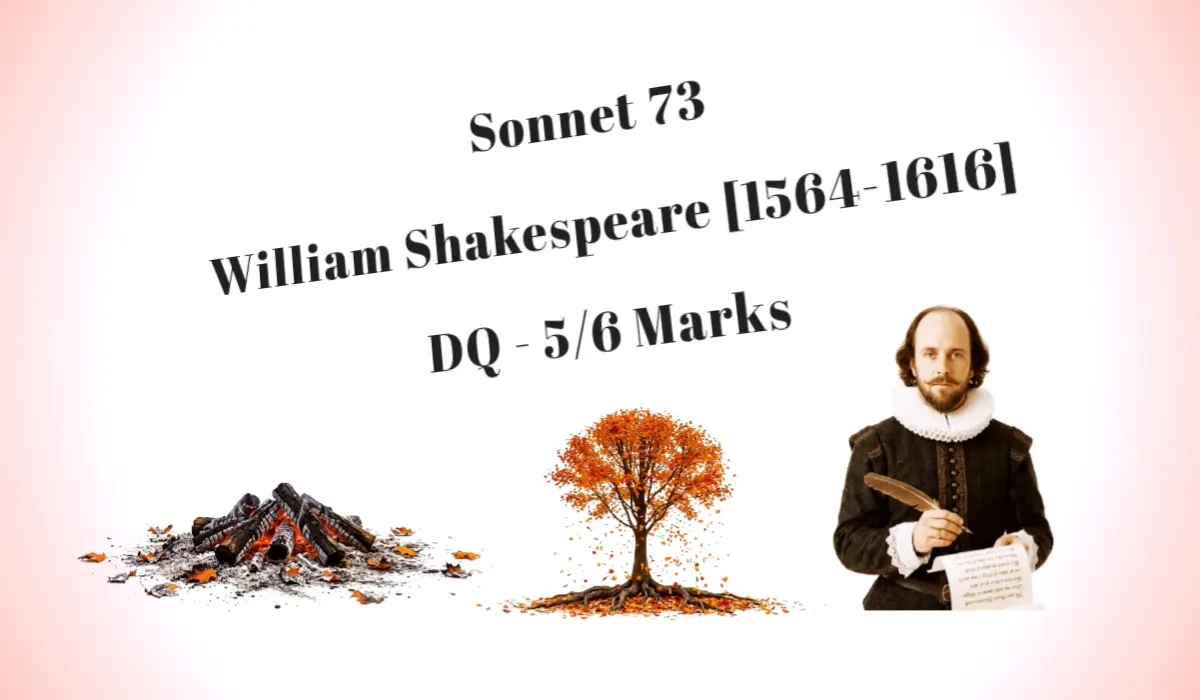
In ‘Sonnet 73’ Shakespeare uses three simple images to talk about his old age and coming death.
At first, he compares himself to a late autumn season. He sees himself as a tree that has lost its leaves and is now cold and empty like a ruined church choir where no birds sing anymore.
Next, he compares his life to the end of a day. He is like the fading light of twilight just before night comes, which stands for death.
Lastly, he uses the image of a dying fire. He is like a fire that is almost out, burning on the ashes of its younger years.
These three images of a fading season, a dying day, and a weak fire all show how life and time are slipping away. Finally, he suggests this awareness makes love stronger. The beloved loves him more because they know his time is short.
DELVE DEEP
Q1. ‘In me thou see’st the twilight of such day /As after sunset fadeth in the west’ — How does the poet use the image of sunset to convey the theme of aging? Explain how this imagery connects to the overall message of the sonnet. (3+3)
The poet uses the image of a sunset to convey the theme of aging by comparing his life to a day that is ending. The fading sunlight in the western sky symbolizes the decline of his youth and vitality, while the approaching ‘black night’ represents old age and ultimate death.
This imagery connects to the overall message of the sonnet, which is about the transience of life, love, and mortality. The twilight image is one of three metaphors used in the poem to illustrate the theme of senile decay and ultimate death along with the bare tree in autumn and the dying fire.
Q2. ‘That time of year thou mayst in me behold /When yellow leaves, or none, or few, do hang’ — Why does the poet mention ‘yellow leaves, or none, or few’? How does this imagery reflect the poet’s feelings about aging and life? (3+3)
In his ‘Sonnet 73’ Shakespeare portrays the time of year namely the autumn, a time of year when leaves turn yellow and fall, leaving the tree bare. This process is a metaphor for aging, where a person’s physical and mental abilities decline, leading to inevitable death. The poet uses the specific phrases ‘yellow leaves, or none, or few’ to accurately portray the process of decay.
The imagery of a tree losing its leaves evokes a sense of degeneration and final destruction. The answer also states that while the poet seems to be a little sad about his aging, he has accepted it as a natural part of life.
Final Thoughts on Sonnet 73
After analysing the above questions and answers, we see how William Shakespeare, in his timeless ‘Sonnet 73’, uses nature’s cycles to mirror human life and intensify the power of love. What do you think about the poem? Which question do you like most? Drop your comment below, and don’t forget to bookmark this page and share it with your friends who are studying William Shakespeare and preparing in English literature and language!