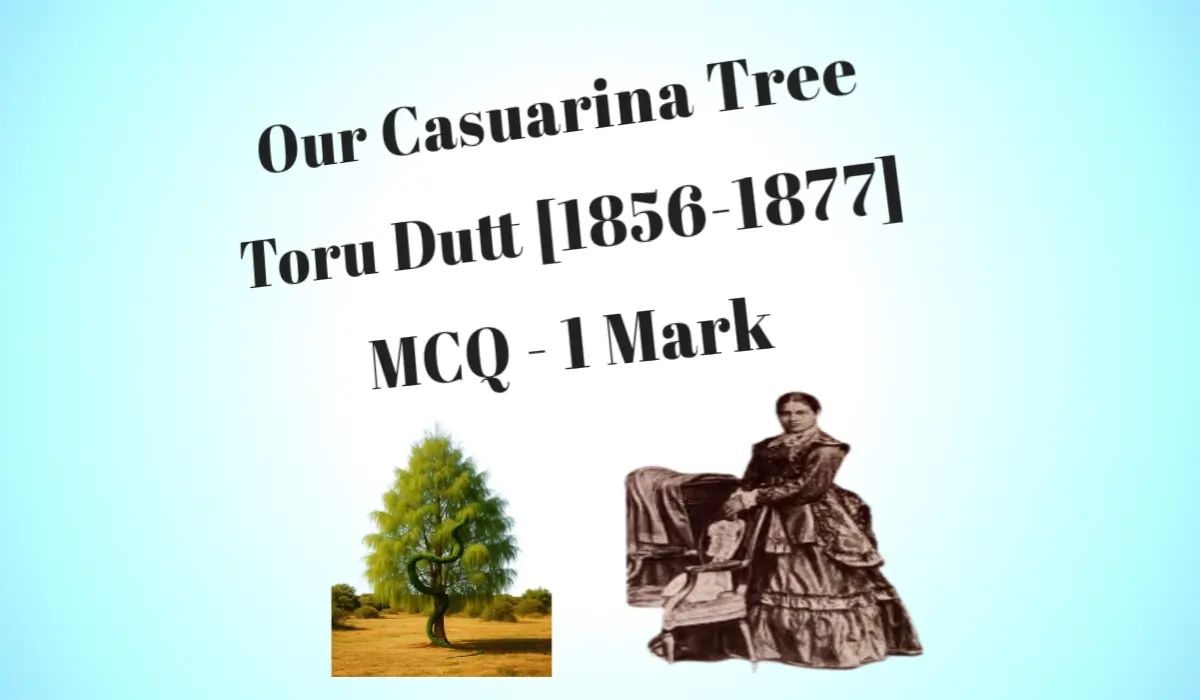
Our Casuarina Tree MCQ
Our Casuarina Tree – An Autobiographical Nostalgic and Evocative Poem
Toru Dutt [1856-1877]
MCQ – 1 Mark
Different Categorical Important Questions
Informative
Q1. The poet of the poem ‘Our Casuarina Tree’ is —
(A) Aru Dutt.
(B) P. Lal.
(C) Kamala Das.
(D) Toru Dutt.
View Answer & Explanation
Correct Answer: (D) Toru Dutt.
Explanation: Toru Dutt, an Indian Bengali poet, wrote the poem ‘Our Casuarina Tree’ in 1873 during the final years of her life.
Q2. Toru Dutt’s birth name was —
(A) Tara Dutta.
(B) Taralata Dutta.
(C) Tarulatta Dutta.
(D) Torubala Datta.
View Answer & Explanation
Correct Answer: (C) Tarulatta Dutta.
Explanation: Toru Dutt’s childhood name was Tarulatta Dutta, but she was popularly known as Toru Dutt.
Q3. Toru Dutt was born on —
(A) March 4, 1856.
(B) March 4, 1756.
(C) March 8, 1856.
(D) March 6, 1856.
View Answer & Explanation
Correct Answer: (A) March 4, 1856.
Explanation: The Indian Bengali poetess Toru Dutt was born on March 4, 1856 at 12 Maniktollah Street, Rambagan, Calcutta, Bengal, British India.
Q4. Toru Dutt was later converted to —
(A) Jainism.
(B) Buddhism.
(C) Islam.
(D) Christianity.
View Answer & Explanation
Correct Answer: (D) Christianity.
Explanation: Along with her family, Toru Dutt embraced Christianity later in life, a shift that profoundly influenced her personal views and cross-cultural themes.
Q5. Toru Dutt had a great influence on —
(A) American modernist poetry.
(B) French Literature.
(C) Indo-Anglian poetry.
(D) Indian folktales.
View Answer & Explanation
Correct Answer: (C) Indo-Anglian poetry.
Explanation: Toru Dutt is regarded as a foundational figure in Indo-Anglian poetry, paving the way for future generations of Indian authors writing in English.
Q6. Toru Dutt’s first work was published in —
(A) 1874.
(B) 1870.
(C) 1876.
(D) 1880.
View Answer & Explanation
Correct Answer: (A) 1874.
Explanation: Toru Dutt’s literary debut occurred in 1874 when her earliest essay and translations began appearing in local publication channels like the Bengal Magazine.
Q7. Toru Dutt got her primary education in —
(A) Delhi.
(B) Ranchi.
(C) Patna.
(D) Kolkata.
View Answer & Explanation
Correct Answer: (D) Kolkata.
Explanation: Born in an aristocratic family in Kolkata (then Calcutta) Toru Dutt received her primary education and tutoring in this cultural hub.
Q8. Toru Dutt’s family converted to Christianity in —
(A) 1862.
(B) 1864.
(C) 1870.
(D) 1872.
View Answer & Explanation
Correct Answer: (A) 1862.
Explanation: Led by her father Govind Chandra Dutt the entire family officially converted and was baptized into Christianity in the year 1862.
Q9. Her family travelled to Europe in —
(A) 1860.
(B) 1869.
(C) 1875.
(D) 1880.
View Answer & Explanation
Correct Answer: (B) 1869.
Explanation: In 1869 the Dutt family left India and traveled to Europe making Toru and her sister among the first Bengali girls to make a sea voyage to the West.
Q10. Toru’s ‘Our Casuarina Tree’ was published in —
(A) 1881.
(B) 1875.
(C) 1882.
(D) 1886.
View Answer & Explanation
Correct Answer: (A) 1881.
Explanation: Her most famous lyrical literary piece ‘Our Casuarina Tree’ was originally published in the year 1881.
Q11. The poem ‘Our Casuarina Tree’ was published in the poetry collection —
(A) Songs of Casuarina Tree.
(B) Modern Poems of India.
(C) Tales of Hindus.
(D) Ancient Ballads and Legends of Hindustan.
View Answer & Explanation
Correct Answer: (D) Ancient Ballads and Legends of Hindustan.
Explanation: The poignant poem ‘Our Casuarina Tree’ is a core inclusion within Toru Dutt’s famous posthumous poetry collection Ancient Ballads and Legends of Hindustan.
Q12. The tree mentioned in the poem is a —
(A) Neem.
(B) Banyan.
(C) Peepal.
(D) Casuarina.
View Answer & Explanation
Correct Answer: (D) Casuarina.
Explanation: The specific tree celebrated throughout the verses of the poem as a symbol of nostalgic childhood memories is the Casuarina tree.
Q13. The setting of the poem ‘Our Casuarina Tree’ is —
(A) a serene garden.
(B) a vast desert.
(C) a vast valley.
(D) a hilltop.
View Answer & Explanation
Correct Answer: (A) a serene garden.
Explanation: Toru Dutt chooses a serene garden as the setting of the poem, which serves as the peaceful backdrop where she fondly recalls her childhood.
Q14. The two siblings of the poet are —
(A) Aru and Abju.
(B) Apu and Rupu.
(C) Anu and Ava.
(D) Apa and Ana.
View Answer & Explanation
Correct Answer: (A) Aru and Abju.
Explanation: In her autobiographical poem ‘Our Casuarina Tree’ Toru Dutt mentions her two dear siblings Aru and Abju, whose memory and companionship are deeply intertwined with her love for the tree.
Q15. ‘Our Casuarina Tree’ by Toru Dutt has a deep —
(A) historical significance.
(B) political importance.
(C) personal relation.
(D) economic impact.
View Answer & Explanation
Correct Answer: (C) personal relation.
Explanation: Toru Dutt, in her autobiographical poem, presents the tree as a powerful symbol of her intense emotional bond with her two dear lost siblings, so the is obviously a deep personal one.
Q16. The Casuarina tree bore the poet’s happy memories and sweet companions of her —
(A) childhood.
(B) adulthood.
(C) young adulthood.
(D) old age.
View Answer & Explanation
Correct Answer: (A) childhood.
Explanation: The Casuarina tree, the central to the poet’s happy memories, represents the innocence and joy of her early childhood spent with her brother and sister.
Q17. The tree is described in the poem as —
(A) dark and twisted.
(B) small and fragile.
(C) majestic and grand.
(D) crooked and gnarled.
View Answer & Explanation
Correct Answer: (C) majestic and grand.
Explanation: Toru Dutt describes the tree as majestic and grand, standing tall as a magnificent giant covered in a colorful creeper that acts like a scarf.
Q18. In the poem ‘Our Casuarina Tree’ a ‘python’ refers to —
(A) a bird.
(B) a creeper.
(C) a flower.
(D) a leaf.
View Answer & Explanation
Correct Answer: (B) a creeper.
Explanation: In the poem ‘python’ refers to a massive creeper winding tightly around the rugged trunk, winding up like a huge snake up to its summit.
Q19. The poem ‘Our Casuarina Tree’ represents the poet’s strong connection with —
(A) history.
(B) nature.
(C) politics.
(D) science.
View Answer & Explanation
Correct Answer: (B) nature.
Explanation: Using the grand Casuarina tree as a bridge to her deepest personal emotions and memories, Toru Dutt, in this poem, presents her strong connection with nature.
Q20. The season evoked in the poem is —
(A) summer.
(B) winter.
(C) autumn.
(D) spring.
View Answer & Explanation
Correct Answer: (B) winter.
Explanation: The poet presents winter, which is highlighted when a gray baboon sitting alone like a statue on the tree’s crest at dawn.
Q21. The creature described as wrapping around the tree is —
(A) a rat.
(B) a squirrel.
(C) a monkey.
(D) a python.
View Answer & Explanation
Correct Answer: (D) a python.
Explanation: The creature described as wrapping around the tree is a python, which wraps tightly around the rugged trunk of the tree.
Q22. The trunk of the tree in ‘Our Casuarina Tree’ is —
(A) polished.
(B) rough.
(C) slender.
(D) soft.
View Answer & Explanation
Correct Answer: (B) rough.
Explanation: In the poem the trunk of the tree is described as rough and rugged, bearing deep marks and scars where the python-like creeper winds tightly around it.
Q23. The time of day mentioned in the first stanza is —
(A) afternoon.
(B) dusk.
(C) morning.
(D) evening.
View Answer & Explanation
Correct Answer: (B) dusk.
Explanation: At the end of the first stanza it is clearly mentioned the garden overflowing with a sweet song at night while men repose, which means the time of day is dusk.
Q24. ‘The giant wears a scarf’ Here the ‘giant’ refers to —
(A) the Casuarina tree.
(B) the pond.
(C) the moon.
(D) the garden.
View Answer & Explanation
Correct Answer: (A) the Casuarina tree.
Explanation: Here the ‘giant’ refers to the majestic Casuarina tree which is deeply intertwined with the poet’s childhood memories.
Q25. In the poem ‘Our Casuarina Tree’ by Toru Dutt ___________ are seen on the tree.
(A) red roses
(B) blue bells
(C) crimson blooms
(D) white lilies
View Answer & Explanation
Correct Answer: (C) crimson blooms
Explanation: Toru Dutt mentions bright crimson blooms seen hanging in clusters all among the boughs of the tree, attracting birds and bees to its colorful branches.
Q26. In ‘Our Casuarina Tree’ Toru Dutt symbolically evokes the tree’s sound, which is —
(A) a roar.
(B) a rustle.
(C) a murmur.
(D) a musical hum.
View Answer & Explanation
Correct Answer: (C) a murmur.
Explanation: In her autobiographical poem ‘Our Casuarina Tree’ Toru Dutt symbolically evokes the tree’s sound as a gentle, mysterious murmur which is considered as tree’s emotional lament.
Q27. The animals that sit on the tree’s branches or the flowers are —
(A) monkeys and squirrels.
(B) mice and raccoons.
(C) birds and bees.
(D) snakes and lizards.
View Answer & Explanation
Correct Answer: (C) birds and bees.
Explanation: It is clearly mentioned that all day vibrant birds and bees gather among all the boughs with bright crimson flowers.
Q28. The sweet songbird in Toru Dutt’s poem ‘Our Casuarina Tree’ that overflows at night is a /an —
(A) darkling.
(B) nightingale.
(C) cricket.
(D) owl.
View Answer & Explanation
Correct Answer: (A) darkling.
Explanation: At night the sweet melody of one overflowing the garden is described as being sung darkling (in the dark) from the tree while human beings rest.
Q29. The song of the Kokila was heard —
(A) in the afternoon.
(B) at midnight.
(C) in the evening.
(D) in the morning.
View Answer & Explanation
Correct Answer: (D) in the morning.
Explanation: The poem clearly states that far and near the kokilas (cuckoos) wake up to hail the dawn.
Q30. According to the poet in ‘Our Casuarina Tree’, the giant tree’s impact on the atmosphere is that —
(A) it creates silence.
(B) it beautifies the scene.
(C) it spreads horror.
(D) it lightens the area.
View Answer & Explanation
Correct Answer: (B) it beautifies the scene.
Explanation: According to Toru Dutt, the giant Casuarina tree enhances the atmosphere with a grey baboon sitting statue-like on the top of the tree and its offspring leaping about and playing, cuckoos singing, and water-lilies blooming in its shadow.
Q31. The poet’s casement is fully open at —
(A) dusk.
(B) noon.
(C) night.
(D) dawn.
View Answer & Explanation
Correct Answer: (D) dawn.
Explanation: The poet explicitly states that her casement (window) is thrown wide open at dawn.
Q32. The poet’s gaze falls on the tree when she opens her —
(A) rooftop.
(B) window.
(C) door.
(D) gate.
View Answer & Explanation
Correct Answer: (B) window.
Explanation: When the poet wide opens her casement (window) at dawn, her eyes instantly fall on the majestic Casuarina tree and become delighted.
Q33. The poet most often observes the tree’s top during —
(A) autumn.
(B) summer.
(C) monsoon.
(D) winter.
View Answer & Explanation
Correct Answer: (D) winter.
Explanation: In winter the poet most often observes the tree’s top because, at that time, generally a grey baboon sits statue-like alone on its crest.
Q34. The baboon is depicted as sitting —
(A) silently.
(B) on a lower bough.
(C) in a group.
(D) alone.
View Answer & Explanation
Correct Answer: (D) alone.
Explanation: Mostly in winter the poet observes a grey baboon sits completely statue-like alone on the very top branch of the tree.
Q35. The baboon watches —
(A) the trees.
(B) the sunrise.
(C) the clouds.
(D) the flowers.
View Answer & Explanation
Correct Answer: (B) the sunrise.
Explanation: At dawn, it is mentioned that a gray baboon, sitting statue-like alone on the very top of the tree, quietly watches the beautiful sunrise.
Q36. The baboon’s young offspring is described as —
(A) weak but agile.
(B) short and strong.
(C) active and agile.
(D) small and weak.
View Answer & Explanation
Correct Answer: (D) small and weak.
Explanation: When the gray baboon watches the sunrise, sitting on the top of the tree, its young offspring actively leap about and and play in the lower branches of the tree.
Q37. The sleepy cows are moving towards their —
(A) shed.
(B) offsprings.
(C) mates.
(D) pastures.
View Answer & Explanation
Correct Answer: (D) pastures.
Explanation: As far and near kokilas (cuckoos) hail the day, the sleepy cows are slowly headed out towards their pastures (open grazing fields).
Q38. In the poem ‘Our Casuarina Tree’ the tree casts its shadow over a —
(A) river.
(B) lake.
(C) broad tank.
(D) pathway.
View Answer & Explanation
Correct Answer: (C) broad tank.
Explanation: The giant casuarina tree casts its vast, beautiful shadow directly on the water of the broad tank by the tree.
Q39. In the poem ‘Our Casuarina Tree’ the water-lilies are compared to —
(A) clouds
(B) frost
(C) stars
(D) snow.
View Answer & Explanation
Correct Answer: (D) snow.
Explanation: The white water-lilies blooming beautifully in the water tank are described as looking snow enmassed.
Q40. By the phrase ‘not because of its magnificence’ Toru Dutt in ‘Our Casuarina Tree’ indicates that —
(A) the tree is withered.
(B) the tree’s beauty is not the reason for its importance.
(C) the tree is old.
(D) the tree has no significance.
View Answer & Explanation
Correct Answer: (B) the tree’s beauty is not the reason for its importance.
Explanation: By the phrase ‘not because of its magnificence’, the poet clarifies that the tree is precious to her because of the sweet childhood memories shared with her siblings beneath it, rather than just its grand physical appearance.
Q41. The poet considers the Casuarina tree —
(A) enemy of all.
(B) dull.
(C) dear to her soul.
(D) fearful.
View Answer & Explanation
Correct Answer: (C) dear to her soul.
Explanation: The poet considers the Casuarina tree dear to her soul because of its very deep connection to her childhood memories shared with her beloved siblings beneath it.
Q42. The activities that the poet reminisces about under the tree are —
(A) sleeping.
(B) chatting.
(C) singing.
(D) playing.
View Answer & Explanation
Correct Answer: (D) playing.
Explanation: The poet fondly remembers her childhood memories of the sweet, carefree days when she and her siblings used to play together underneath its massive branches.
Q43. The emotion that the poet enjoys with her siblings is —
(A) sadness.
(B) anger.
(C) love.
(D) indifference.
View Answer & Explanation
Correct Answer: (C) love.
Explanation: Toru Dutt enjoys an emotional warmth of love, an intense affection with her siblings beneath her dear Casuarina tree.
Q44. The tree will forever hold a special place in the poet’s heart because of —
(A) its tall size.
(B) the memories of her companions.
(C) its beautiful flowers.
(D) its shade.
View Answer & Explanation
Correct Answer: (B) the memories of her companions.
Explanation: The poet firmly believes that the Casuarina tree will forever hold a special place in her heart because of her childhood memories of her childhood companions, her beloved brother and sister, with whom she played beneath the grand Casuarina tree.
Q45. The phrase ‘hot tears blind mine eyes’ expresses —
(A) anger.
(B) sorrow.
(C) indifference.
(D) joy.
View Answer & Explanation
Correct Answer: (B) sorrow.
Explanation: By this poignant phrase ‘hot tears blind mine eyes’, the poet conveys her overwhelming grief as she remembers her deceased siblings, Aru and Abju.
Q46. The phrase a ‘dirge-like murmur’ implies —
(A) the tree’s lament.
(B) the rain.
(C) the sea.
(D) the wind.
View Answer & Explanation
Correct Answer: (A) the tree’s lament.
Explanation: The phrase actually indicates the rustling of the tree’s leaves that is personified as a mournful song or funeral chant, expressing deep sympathy and grief for the poet’s heavy personal losses.
Q47. The murmur is likened to the sound of —
(A) lightning.
(B) thunderstorm.
(C) a waterfall.
(D) the sea crashing against a shingle.
View Answer & Explanation
Correct Answer: (D) the sea crashing against a shingle.
Explanation: To the poet, the mournful murmur of the tree is like the sound of the sea waves crashing against a pebbled shoreline.
Q48. The poet implies that the murmur of tree might reach —
(A) her dreams.
(B) the unknown land.
(C) the hilltop.
(D) her infancy.
View Answer & Explanation
Correct Answer: (D) her infancy.
Explanation: According to Toru Dutt’s thinking, the mournful murmur of the tree is so powerful that it can travel across space and reach the mysterious, distant land where her deceased siblings now rest.
Q49. The phrase ‘unknown, yet well-known to the eye of faith’ signifies that the unknown land is —
(A) full of dreams.
(B) mysterious but somewhat familiar.
(C) full of flowers.
(D) a place of horror.
View Answer & Explanation
Correct Answer: (B) mysterious but somewhat familiar.
Explanation: By this phrase the poet signifies the unknown, well-known life after death, the life which remains physically hidden and mysterious, but it is deeply familiar and real through one’s spiritual intuition and belief.
Q50. The poet thinks back hearing tree’s wail in —
(A) China.
(B) England.
(C) France or Italy.
(D) India.
View Answer & Explanation
Correct Answer: (C) France or Italy.
Explanation: In the poem the poet clearly mentions two European countries, France and Italy, where she thinks she still can hear the mournful, nostalgic echo of her dear Casuarina tree in her mind.
Q51. In ‘Our Casuarina Tree’ the creature lying in slumber is —
(A) the owl.
(B) a dragon.
(C) the water spirit.
(D) water-lilies.
View Answer & Explanation
Correct Answer: (C) the water spirit.
Explanation: The poem mentions the water-wraith slumbers in his cave, emphasizing the peaceful silence in the landscape.
Q52. In the poem ‘Our Casuarina Tree’ the waves are described as gently kissing the —
(A) tree.
(B) cave.
(C) mountain.
(D) shore.
View Answer & Explanation
Correct Answer: (D) shore.
Explanation: The poet describes the sea waves gently kissed the classic shore of France or Italy, beneath the bright moonlight.
Q53. The shore is portrayed as —
(A) empty.
(B) classic.
(C) rocky.
(D) mysterious.
View Answer & Explanation
Correct Answer: (B) classic.
Explanation: The poet explicitly mentions the sea waves gently kissed the classic shore of France or Italy.
Q54. The poet imagines the scene of France or Italy on —
(A) moonlight.
(B) streetlight.
(C) candle light.
(D) sunlight.
View Answer & Explanation
Correct Answer: (A) moonlight.
Explanation: Toru Dutt imagines the landscape of these two European countries illuminated by moonlight, as noted in the line describing the shores of France or Italy ‘beneath the moon’.
Q55. In the poem ‘Our Casuarina Tree’ the phrase ‘earth lay tranced in a dreamless swoon’ symbolizes that the earth is —
(A) asleep.
(B) in pain.
(C) remorse.
(D) in a deep sleep.
View Answer & Explanation
Correct Answer: (D) in a deep sleep.
Explanation: By using the phrase, the poet symbolizes the earth being in a profound, peaceful sleep, capturing a state of utter stillness and quiet trance at night.
Q56. ________ appears in the poet’s inner vision as the music rises.
(A) The waterfall
(B) The pole star
(C) The moon
(D) A form sublime
View Answer & Explanation
Correct Answer: (D) A form sublime
Explanation: As the mournful murmur of the Casuarina tree rises, an exalted (sublime) form of the tree appears clearly before the poet’s inner vision.
Q57. The poet wishes to dedicate to the tree —
(A) a song.
(B) a picture.
(C) a music.
(D) a poem.
View Answer & Explanation
Correct Answer: (A) a song.
Explanation: To honor the beloved casuarina tree, the poet wishes to dedicate a ‘lay’ which directly translates to a song.
Q58. In the poem ‘Our Casuarina Tree’ the persons who are in ‘blessed sleep’ are —
(A) the flowers.
(B) the birds.
(C) her loved ones who have passed away.
(D) the poet’s fore bearers.
View Answer & Explanation
Correct Answer: (C) her loved ones who have passed away.
Explanation: By using the phrase ‘blessed sleep’, the poet refers to the eternal sleep (death) of her two beloved siblings, Aru and Abju, who passed away at a young age.
Q59. The nearest in meaning to ‘fain’ is —
(A) reluctantly.
(B) remorsefully.
(C) sadly.
(D) gladly.
View Answer & Explanation
Correct Answer: (D) gladly.
Explanation: The nearest meaning of the archaic word ‘fain’ is to do something ‘gladly’ or willingly.
Q60. In her poem ‘Our Casuarina Tree’ the poet presents the tree’s significance as. —
(A) stoic to life.
(B) indifferent to life.
(C) remorseful to life.
(D) dearer than life.
View Answer & Explanation
Correct Answer: (D) dearer than life.
Explanation: The poet clearly mentions ‘Dear is the Casuarina to my soul’ because beneath this grand tree she played with her beloved siblings who were ‘dearer than life’ to her.
Q61. After her death, the poet desires that the tree be remembered among —
(A) withered tree.
(B) other trees.
(C) deathless trees.
(D) fallen trees.
View Answer & Explanation
Correct Answer: (C) deathless trees.
Explanation: After her death, the poet passionately desires that her beloved casuarina tree be immortalized and numbered among the world’s ‘deathless trees’, untouched by the passage of time.
Q62. The phrase ‘deathless trees’ represents —
(A) trees in her garden.
(B) trees that bloom year-round.
(C) trees that do not wither.
(D) legendary or eternal trees.
View Answer & Explanation
Correct Answer: (D) legendary or eternal trees.
Explanation: The phrase ‘deathless trees’ symbolizes legendary or eternal trees that have been permanently preserved through great literature.
Q63. The place referred to alongside the deathless trees is —
(A) a pond.
(B) Borrowdale.
(C) the Alps.
(D) a monument.
View Answer & Explanation
Correct Answer: (B) Borrowdale.
Explanation: The poet directly refers Borrowdale alongside the deathless trees, evoking William Wordsworth’s famous poem about the sacred, eternal yew-trees of that valley.
Q64. The poet in her poem ‘Our Casuarina Tree’ depicted time as —
(A) a pond.
(B) a rock.
(C) a lake.
(D) a shadow.
View Answer & Explanation
Correct Answer: (D) a shadow.
Explanation: To emphasize the transience of human life, the poet personifies time as a fleeting shadow alongside fear, hope, and death.
Q65. The emotion conveyed the poet in her verse is —
(A) laugh.
(B) arrogance.
(C) weakness.
(D) remorse.
View Answer & Explanation
Correct Answer: (C) weakness.
Explanation: The poet humbly refers to her own creative effort as a ‘weak’ verse that might not do justice to the immense beauty of the tree.
Q66. In ‘Our Casuarina Tree’ the poet wishes that love will save the tree from —
(A) human attacks.
(B) insects.
(C) diseases.
(D) forgetting’s fate.
View Answer & Explanation
Correct Answer: (D) forgetting’s fate.
Explanation: At the end of the poem, the poet wishes that the enduring power of Love will protect the tree from ‘Oblivion curse’ (forgetting’s fate).
Q67. The number of stanzas included in the poem ‘Our Casuarina Tree’ is —
(A) six.
(B) five.
(C) seven.
(D) four.
View Answer & Explanation
Correct Answer: (B) five.
Explanation: Toru Dutt’s ‘Our Casuarina Tree’ consists of five stanzas, each following an intricate eleven-line rhyme scheme.
Q68. The nearest in meaning to ‘consecrate’ is —
(A) accept.
(B) reject.
(C) ignore.
(D) dedicate.
View Answer & Explanation
Correct Answer: (D) dedicate.
Explanation: The word ‘consecrate’ means to dedicate or to make holy something sacred to a specific, revered purpose.
Q69. The phrase ‘blessed sleep’ means —
(A) death.
(B) regeneration.
(C) rebirth.
(D) a divine love.
View Answer & Explanation
Correct Answer: (A) death.
Explanation: The phrase ‘blessed sleep’ is used as a peaceful euphemism for death, referring to the eternal rest of the poet’s departed siblings.
Q70. The meaning of the word ‘oblivion’ is —
(A) obscurity.
(B) attention.
(C) awareness.
(D) destruction.
View Answer & Explanation
Correct Answer: (A) obscurity.
Explanation: The poet uses the word ‘oblivion’ to signify the state of being forgotten, unremembered, or fading away into total obscurity.
——————
Fill in the Blanks
Q1. The creeper that winding round and round the Casuarina tree climbs up to the ______ branch of the tree.
(A) main
(B) lower
(C) top
(D) middle
View Answer & Explanation
Correct Answer: (C) top
Explanation:
Q2. ‘The ______ wears the scarf.’
(A) poet’s friend
(B) readers
(C) poet
(D) giant
View Answer & Explanation
Correct Answer: (D) giant
Explanation:
Q3. The poet reminisces about the clusters of ______ flowers that hang all around the branches of the crimson tree.
(A) maroon
(B) crimson
(C) scarlet
(D) burgundy
View Answer & Explanation
Correct Answer: (B) crimson
Explanation:
Q4. The sweet song of the ______ fills the garden at night.
(A) nightingale
(B) owl
(C) darkling
(D) robin
View Answer & Explanation
Correct Answer: (C) darkling
Explanation:
Q5. ‘When my ______ is wide open thrown.’
(A) gate
(B) casement
(C) curtain
(D) windowpane
View Answer & Explanation
Correct Answer: (B) casement
Explanation:
Q6. A gray ______ sits still to observe the sunrise.
(A) baboon
(B) squirrel
(C) robin
(D) owl
View Answer & Explanation
Correct Answer: (A) baboon
Explanation:
Q7. Gradually, the bird Kokilas begin to ______ the day with their song.
(A) greet
(B) ignore
(C) reject
(D) dismiss
View Answer & Explanation
Correct Answer: (A) greet
Explanation:
Q8. The poet observes drowsy cows making their way to the ______.
(A) stables
(B) forests
(C) shade
(D) pastures
View Answer & Explanation
Correct Answer: (D) pastures
Explanation:
Q9. In the poem ‘Our Casuarina Tree’ the ______ appear like a mass gathered snow.
(A) roses
(B) water-lilies
(C) marigolds
(D) tulips
View Answer & Explanation
Correct Answer: (B) water-lilies
Explanation:
Q10. The poet expresses that she cherishes joyful memories with her ______ under the tree.
(A) neighbours
(B) parents
(C) relatives
(D) companions
View Answer & Explanation
Correct Answer: (D) companions
Explanation:
Q11. ‘In memory, till the ______ tears blind my eyes.’
(A) soft
(B) hot
(C) cold
(D) lukewarm
View Answer & Explanation
Correct Answer: (B) hot
Explanation:
Q12. The poet was now residing in some foreign country of ______.
(A) India or Bangladesh
(B) Nepal or Bhutan
(C) France or Italy
(D) China or Hong Kong
View Answer & Explanation
Correct Answer: (C) France or Italy
Explanation:
Q13. According to the poet, the tree seems to mourn for her ______ and ______ respectively.
(A) aunt – niece
(B) brother – sister
(C) father – mother
(D) friend – neighbour
View Answer & Explanation
Correct Answer: (B) brother – sister
Explanation:
Q14. ‘I saw thee, in my own loved native ______.’
(A) clime
(B) city
(C) county
(D) country
View Answer & Explanation
Correct Answer: (A) clime
Explanation:
Q15. The poet composed a song to honour her dear ______ tree.
(A) Neem
(B) Pine
(C) Cherry
(D) Casuarina
View Answer & Explanation
Correct Answer: (D) Casuarina
Explanation:
——————
Column Matching Type
1. Match the words in Column A with the contents in Column B.
| Column A | Column B |
| (i) python | (a) a deep red colour |
| (ii) embraces | (b) a large snake |
| (iii) scarf | (c) holds tightly |
| (iv) crimson | (d) a long piece of fabric worn around the neck or shoulder |
Options
(A) (i)–(a), (ii)–(c), (iii)–(b), (iv)–(d)
(B) (i)–(b), (ii)–(c), (iii)–(d), (iv)–(a)
(C) (i)–(d), (ii)–(c), (iii)–(b), (iv)–(a)
(D) (i)–(c), (ii)–(a), (iii)–(d), (iv)–(b)
2. Match the words in Column A with the contents in Column B.
| Column A | Column B |
| (i) baboon | (a) to greet or salute with enthusiasm |
| (ii) offspring | (b) grazing land |
| (iii) hail | (c) an animal’s young |
| (iv) pastures | (d) a kind of large monkey |
Options
(A) (i)–(d), (ii)–(a), (iii)–(c), (iv)–(b)
(B) (i)–(a), (ii)–(c), (iii)–(b), (iv)–(d)
(C) (i)–(d), (ii)–(c), (iii)–(a), (iv)–(b)
(D) (i)–(c), (ii)–(b), (iii)–(d), (iv)–(a)
3. Match the words in Column A with the contents in Column B.
| Column A | Column B |
| (i) magnificence | (a) a lament for the dead |
| (ii) companions | (b) strange and frightening |
| (iii) dirge | (c) great beauty or splendour |
| (iv) eerie | (d) friends or associates who share experiences |
Options
(A) (i)–(d), (ii)–(b), (iii)–(c), (iv)–(a)
(B) (i)–(c), (ii)–(a), (iii)–(d), (iv)–(b)
(C) (i)–(a), (ii)–(c), (iii)–(b), (iv)–(d)
(D) (i)–(c), (ii)–(d), (iii)–(a), (iv)–(b)
4. Match the words in Column A with the contents in Column B.
| Column A | Column B |
| (i) haply | (a) protected from danger |
| (ii) sheltered | (b) in a state of sleep |
| (iii) tranced | (c) noble |
| (iv) sublime | (d) by any chance |
Options
(A) (i)–(d), (ii)–(a), (iii)–(b), (iv)–(c)
(B) (i)–(a), (ii)–(c), (iii)–(d), (iv)–(b)
(C) (i)–(b), (ii)–(a), (iii)–(d), (iv)–(c)
(D) (i)–(c), (ii)–(b), (iii)–(d), (iv)–(a)
5. Match the words in Column A with the contents in Column B.
| Column A | Column B |
| (i) fain | (a) a song |
| (ii) consecrate | (b) obscurity |
| (iii) lay | (c) gladly |
| (iv) oblivion | (d) dedicate |
Options
(A) (i)–(a), (ii)–(c), (iii)–(b), (iv)–(d)
(B) (i)–(c), (ii)–(d), (iii)–(b), (iv)–(a)
(C) (i)–(d), (ii)–(c), (iii)–(b), (iv)–(a)
(D) (i)–(c), (ii)–(d), (iii)–(a), (iv)–(b)
—————–
Assertion-Reasoning Type
1. Assertion (A): The creeper wraps itself around the trunk of the Casuarina tree like a scarf.
Reason (R): The Casuarina tree is large and resembles a giant.
Choose the most suitable answer:
(A) A is true but R is false
(B) Both A and R are true
(C) A is false but R is true
(D) Both A and R are false
2. Assertion (A): “The Casuarina tree holds a special place in my heart.”
Reason (R): “We used to play beneath it with our beloved friends.”
Pick the correct option:
(A) A is true while R is not.
(B) A is false but R is true.
(C) Both A and R are incorrect.
(D) A and R are both correct.
3. Assertion (A): During her early years, the poet played under the tree with her siblings.
Reason (R): The poet had no fond recollections of those times.
Select the correct answer:
(A) Both A and R are correct
(B) A is incorrect while R is true
(C) A is correct but R is false
(D) Both A and R are incorrect
4. Assertion (A): The poet wishes the tree would not be remembered indefinitely by future generations.
Reason (R): The tree symbolizes the poet’s cherished recollections of her homeland and associated fond memories.
Choose the correct answer:
(A) Both A and R are correct.
(B) A is correct, but R is incorrect.
(C) Both A and R are incorrect.
(D) A is incorrect, but R is correct.
——————
Sentence-Relationship Type
1. Statement A : Birds and bees congregate around the Casuarina tree.
Statement B : Crimson clusters of flowers adorn all the branches.
Choose the correct relationship between the statements :
(A) Statement A and Statement B are unrelated.
(B) Statement B is the cause of Statement A.
(C) Statement A and B are independent.
(D) Statement A is the cause of Statement B.
2. Statement A : The peak of the Casuarina tree reached the stars.
Statement B : The Casuarina tree was exceptionally tall.
Choose the correct relationship between the statements :
(A) Statement A and B have no correlation.
(B) Statement B is a consequence of Statement A.
(C) Statement B clarifies Statement A.
(D) Statement A is the origin of Statement A.
3. Statement A : The tree’s shadow extends over the tank.
Statement B : The white water-lilies resemble a mass of gathered snow.
Choose the correct relationship between the statements :
(A) Statement A and B are not related.
(B) Statement A is a result of Statement B.
(C) Statement A brings about Statement B.
(D) Statement B provides an explanation for Statement A.
4. Statement A : The poet is currently residing in a foreign country, either France or Italy.
Statement B : The poet’s mental image of the tree’s grand and majestic form fades.
Choose the correct relationship between the statements :
(A) Statement A and Statement B are not connected.
(B) Statement A leads to Statement B.
(C) Statement A and Statement B have no connection.
(D) Statement A is influenced by Statement B.
5. Statement A : The tree symbolizes her pure childhood bond with her siblings.
Statement B : The poet desires to include the tree among Borrowdale’s immortal trees.
Choose the correct relationship between the statements :
(A) Statement A and Statement B are not linked.
(B) Statement B elucidates Statement A.
(C) Statement A is the cause of Statement B.
(D) Statement A and Statement B are unrelated.
——————
Diagram Based Type
1. Suppose the black circle represents the father baboon and the white circle represents the baby baboon. Now, the diagram of the following ones rightly describes the position of the father baboon and baby baboon on the casuarina tree is
(A) ⚪—>⚫
(B) ⚫–>⚪
(C) ⚪—->⚫
(D)⚪——>⚫
2. In the poem ‘Our Casuarina Tree’, a creeper wraps around the stem of the tree like a python. Now, study the following diagrams. The option which best describes the creeper wrapping around the stem of the tree is
(A) ⛓️⚕️🌳
(B) ⛓️💥⚕️🌳
(C) 🔗⚕️🌳
(D) 🧬⚕️🌳
——————
Rearrangement of Sentences
1. Arrange the following sentences in sequential order.
(i) Birds and bees come together.
(ii) The creeper wraps around the tree’s rough trunk like a scarf.
(iii) The clusters of crimson flowers dangle from the boughs.
(iv) The sweet song fills the air.
Options
(A) (iii) → (i) → (ii) → (iv)
(B) (ii) → (iii) → (iv) → (i)
(C) (iv) → (ii) → (iii) → (i)
(D) (iii) → (ii) → (i) → (iv)
2. Arrange the following sentences in sequential order.
(i) The sun rises.
(ii) The Kokilas start to greet the dawn.
(iii) During winter, a gray baboon would perch on one of the tree’s branches.
(iv) The young baboon would jump onto the lower branch.
Options
(A) (iv) → (ii) → (iii) → (i)
(B) (ii) → (i) → (iii) → (iv)
(C) (i) → (iii) → (iv) → (ii)
(D) (iii) → (iv) → (i) → (ii)
3. Arrange the following sentences in sequential order.
(i) The tree is beautiful and gigantic.
(ii) The poet hears a mournful sound from the tree.
(iii) The tree is related to the poet’s siblings.
(iv) The tree evokes memories that cause her eyes to fill with tears.
Options
(A) (iv) → (ii) → (i) → (iii)
(B) (i) → (iii) → (iv) → (ii)
(C) (iii) → (i) → (iv) → (ii)
(D) (i) → (iv) → (ii) → (iii)
4. Arrange the following sentences in sequential order.
(i) The poet hopes that the tree will be remembered along with other trees.
(ii) The poet has a wish to dedicate a song in honour of the tree.
(iii) The poet wishes for the tree’s lasting legacy.
(iv) The poet feels deeply for the tree.
Options
(A) (iii) → (i) → (iv) → (ii)
(B) (ii) → (i) → (iii) → (iv)
(C) (ii) → (iv) → (iii) → (i)
(D) (iii) → (ii) → (iv) → (i)
——————
True and False Type
1. Identify the incorrect statement from the following :
(A) The poet refers to her cherished tree as magnificent.
(B) A creeper twines around the smooth trunk of the tree like a scarf.
(C) Clusters of red flowers hang from the branches.
(D) The sweet song of a lonely bird fills the drowsy night.
2. Identify the correct statement from the following :
(A) The poet is currently either in England or in France.
(B) A gray baboon is observing the sunrise.
(C) Its young one is dodging around.
(D) The cows are walking towards their pastures.
3. Identify the correct statement from the following :
(A) The tree’s shadow is cast over the lake.
(B) The red water-lilies appear like a mass of snow.
(C) The poet and her friends played beneath the tree during their childhood.
(D) Those joyful days are sure to return.
4. The incorrect statement of the following ones is:
(A) The poet wants to dedicate a song in praise of the tree.
(B) The tree holds a deep connection with the poet and her siblings.
(C) Her siblings have passed away.
(D) The poet believes that the tree will not be valued after her death.
——————
Case Based Type
1. “But gallantly / The giant wears the scarf.” The poet makes this statement because
(A) the poet uses this line to portray the tree as majestic and brave. The “scarf” refers to the creeper that wraps around the tree, enhancing its beauty
(B) the poet is likening the “scarf” to the tree’s leaves, suggesting they don’t enhance its beauty and instead highlight its sorrow.
(C) the poet imagines the “scarf” as a mythical being coiling around the tree, emphasizing its grandeur.
(D) the poet compares the “scarf” to a deadly snake wrapped around the tree, intensifying its suffering.
2. “In memory, till the hot tears blind mine eyes! What is that dirge-like murmur that I hear?” The poet describes the tree’s murmur as “dirge-like” because
(A) the poet is deeply moved by the sorrowful murmur, which leaves a lasting impression on her memory
(B) the sound is caused by birds and insects on the branches, and this activity moves the poet to tears of joy
(C) the murmur is called “dirge-like” because it brings out strong emotions of grief and longing. It also represents a lasting emotional connection over time
(D) the murmur symbolizes a new beginning, inspiring the poet to embark on a fresh journey.
3. “O Tree, as in my happy prime / I saw thee, in my own loved native clime.” The poet feels a strong connection to the tree from a distance because
(A) he says the tree provides tasty fruits that everyone enjoys
(B) he admires the tree as it is surrounded by many smaller trees with blooming flowers, creating a beautiful landscape.
(C) he feels joy knowing the tree shelters rare animals and birds, making it stand out among other trees.
(D) he is reminded of the tree by the sound of waves, which brings back cherished memories of home and happiness.
4. “Mayst thou be numbered when my days are done / With deathless trees – like those in Borrowdale.” By wishing the tree to be counted among “deathless trees”
(A) the poet wishes the tree would be worshipped like a goddess
(B) the poet hopes the tree will become part of a forest
(C) the poet wants the tree to be remembered like the legendary trees of Borrowdale
(D) the poet thinks the tree will bring fortune to future generations.
——————
WBCHSE Sample Questions
EXERCISE
Choose the correct answer from the alternatives given :
1. Who is the speaker in the poem?
a) A gardener tending the Casuarina tree
b) A bird singing in the branches of the tree
c) A person reminiscing about childhood memories under the tree
d) A traveler admiring the beauty of the tree
2. What feeling(s) does the speaker associate with the Casuarina tree?
a) Fear and danger
b) Indifference and boredom
c) Comfort, security, and happy memories
d) Loneliness and isolation
3. What is the tone of the poem “Our Casuarina Tree”?
a) Angry and resentful
b) Sarcastic and mocking
c) Bittersweet and nostalgic
d) Playful and lighthearted
——————
WBCHSE Model Questions
1. The speaker in ‘Our Casuarina Tree’ expresses a feeling of :
(A) Contentment and joy
(B) Longing and nostalgia
(C) Fear and anger
(D) Excitement and anticipation
2. The Casuarina tree in the poem is a symbol of :
(A) Strength and resilience
(B) Beauty and serenity
(C) Change and impermanence
(D) Loneliness and isolation
3. What sound does the tree make, according to the poem?
(A) A dirge-like murmur
(B) A sweet song
(C) The rustling of leaves
(D) The baboon’s cry
4. Which phrase best describes the Casuarina tree in the poem?
(A) “A giant wears the scarf”
(B) “A creeper climbs”
(C) “A gray baboon sits”
(D) “Water-lilies spring”
5. What is the main theme explored in ‘Our Casuarina Tree’?
(A) The power of nature
(B) The importance of tradition
(C) The experience of cultural displacement
(D) The passage of time and childhood memories
——————
TEST YOURSELF
Full Marks : 10 ⚪⚪⚪ Time : 15 Minutes
1. Choose the correct answer from the options given :
“Like a huge python, winding round and round / The rugged trunk” The figure of speech used in the line is—
(A) alliteration
(B) metaphor
(C) simile
(D) personification.
2. “But gallantly / The Giant wears the scarf.” The ‘Giant’ in this line refers to—
(A) the Casuarina tree
(B) the creeper
(C) the gray baboon
(D) a mythological creature.
3. The Casuarina tree is dear to the poet’s soul because
(A) the tree is huge and magnificent
(B) the tree looks very beautiful with the winding creeper
(C) the poet has played with her dear companions under this tree and cherished that memory
(D) the poet was reminded of foreign lands with the image of this tree.
4. The false statement among the following ones is
(A) the gray baboon is the mother of the young baboon
(B) the older baboon is sitting very still
(C) the small baboon is jumping and playing on the lower branch of the Casuarina tree
(D) the baboon on the top branch is watching the sunrise.
5. The poet talks about the Casuarina tree in—
(A) France
(B) Italy
(C) Borrowdale
(D) her native land.
6. Assertion : The poet sheds hot tears that blind her eyes.
Reason : She misses the Casuarina tree of her native place very much.
(A) Assertion is wrong but the Reason is right
(B) Assertion is right but the Reason is wrong
(C) Both Assertion and Reason are right
(D) Both Assertion and Reason are wrong
7. “Like those in Borrowdale” — The other poet who used the word ‘Borrowdale’ was
(A) Toru Dutt
(B) Shelley
(C) Wordsworth
(D) Keats
8. “Before mine inner vision rose a form sublime. Thy form, O _____ , as in my happy prime I saw thee.” [Fill in the blank with a suitable alternative]
(A) Tree
(B) Casuarina
(C) Friend
(D) Dear
9. The expression suggests the strength of the Casuarina Tree is
(A) ‘………indented deep with scars’
(B) ‘………in whose embraces bound /No other tree could live.’
(C) ‘By that hoar tree, so beautiful and vast,’
(D) ‘May Love defend thee from Oblivion’s curse.’
10. The bird that greets the morning in the poem Our Casuarina Tree is—
(A) Darkling thrush
(B) Kokila
(C) Cuckoo
(D) Nightingale.
——————
Answer the above questions by darkening the appropriate circle in the mock OMR Sheet given below :
OMR SHEET
| Question Nos. | Answers |
| 1. | Ⓐ Ⓑ Ⓒ Ⓓ |
| 2. | Ⓐ Ⓑ Ⓒ Ⓓ |
| 3. | Ⓐ Ⓑ Ⓒ Ⓓ |
| 4. | Ⓐ Ⓑ Ⓒ Ⓓ |
| 5. | Ⓐ Ⓑ Ⓒ Ⓓ |
| 6. | Ⓐ Ⓑ Ⓒ Ⓓ |
| 7. | Ⓐ Ⓑ Ⓒ Ⓓ |
| 8. | Ⓐ Ⓑ Ⓒ Ⓓ |
| 9. | Ⓐ Ⓑ Ⓒ Ⓓ |
| 10. | Ⓐ Ⓑ Ⓒ Ⓓ |
| Signature of the Invigilator | Marks Obtained |
——————
Leave a Reply